Permission Slip: Why You're Still Waiting for Someone to Tell You Your Outfit Is Good
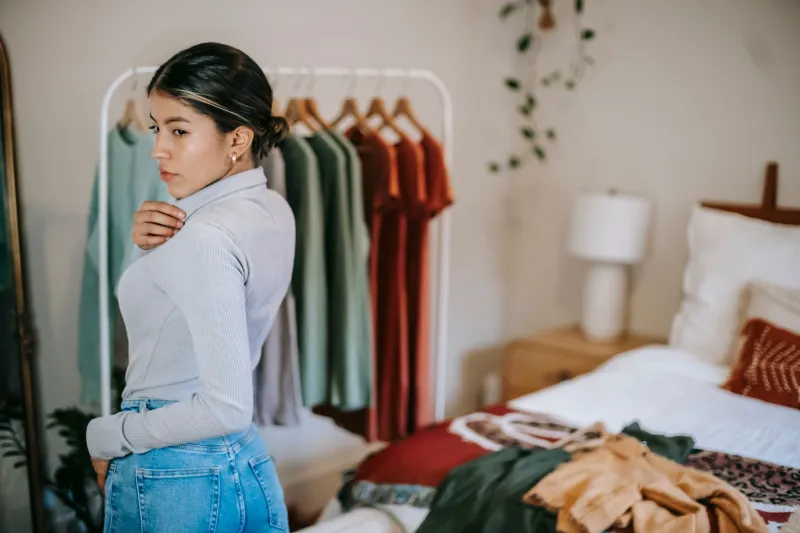
You know the feeling. You've nailed it — the fit is clean, the layers are working, you even got the accessories right. You look in the mirror and there's a moment, just a flash, where you think: yes, this is it. Then you walk out the door and spend the rest of the morning low-key scanning every interaction for some sign that other people think so too.
A compliment from a coworker? Instant relief. Silence? Suddenly you're reconsidering everything. A friend who doesn't say anything about your outfit when they definitely would have if it was good? You're already mentally changing when you get home.
This is the confidence tax. And a lot of us are paying it without even realizing.
The Gap Between Knowing and Feeling
Here's the thing — most people who struggle with outfit validation aren't insecure in the traditional sense. They know they have good taste. They can identify what works aesthetically. They understand the principles of a solid fit. The knowledge is there.
But knowledge and felt confidence are two completely different things. You can know your outfit is great and still need someone else to confirm it before it actually feels great. That gap — between intellectual certainty and emotional security — is where the confidence tax lives.
And Gen Z, more than any generation before, has been trained to close that gap with external data. Likes, comments, saves, the little dopamine hit when a post performs well. The feedback loop is so built into daily life that it's spilled over from social content into real-world dressing.
Social Media Didn't Create This — But It Definitely Made It Worse
Seeking validation for your appearance isn't new. Humans have always been social creatures who care about how they're perceived. But the particular flavor of outfit anxiety that's common right now? That's newer, and social media has a lot to do with it.
When you post a fit and it gets engagement, your brain registers that the outfit was approved. When a post underperforms, something in you files that look away as a risk. Over time, your personal style starts to get filtered through a crowd-sourced editing process where the crowd is thousands of strangers whose preferences you've never actually examined.
The result is this weird phenomenon where people who are genuinely stylish and creative start second-guessing their best ideas because they can't predict how an algorithm will treat them. The outfit that felt most authentically you gets benched in favor of something more likely to perform. And slowly, without meaning to, you start dressing for an audience instead of for yourself.
The Mirror Moment vs. The Door Moment
Pay attention to where your confidence breaks down. For a lot of people, there's a very specific moment when the self-assurance drops — and it's not in front of the mirror. It's right before you walk into a space where other people can see you.
That shift is telling. In front of the mirror, you're the only audience. You're making the call based on your own criteria. The second you step into a shared space, you're suddenly aware of all the other possible opinions, and your own starts to feel less reliable.
This is where it helps to get really honest with yourself: whose opinion are you actually looking for? If you stripped away every possible reaction and dressed in a room where no one would ever see you, what would you put on? The answer to that question is usually a pretty direct line to your actual aesthetic instincts — the ones that exist before anxiety gets involved.
What Self-Assurance Actually Looks Like in Practice
Building genuine style confidence isn't about deciding you don't care what anyone thinks. That's a performance, and it's exhausting. Real self-assurance is more subtle — it's developing enough trust in your own taste that outside opinions become interesting rather than necessary.
A few things that actually help:
Wear the outfit twice before you decide. The first time you wear something new, your brain is still processing it. The second time, you have real data — how it moved, how you felt in it, whether the energy held up. Decisions made after the second wear are almost always more confident.
Stop explaining your outfits before someone questions them. "I know this is kind of a lot" or "this might be too casual" — those preemptive apologies are anxiety talking. When you lead with a disclaimer, you're essentially asking for reassurance before anyone's even reacted. Drop the caveat. Just wear the thing.
Notice when you're dressing for the grid vs. dressing for your life. Not every outfit needs to be postable. Some of your best looks will never make it to social media, and that's actually fine. Dressing for a real moment — a dinner, a drive, an afternoon with friends — is its own reward.
Build a personal reference archive. Screenshots, saved posts, photos of fits you actually loved wearing — create a running record of your own aesthetic instincts. When doubt kicks in, your archive is a reminder that you've made good calls before and you'll make them again.
The Validation You Actually Need
Here's a reframe worth sitting with: the most useful validation you can get for your style choices isn't from other people. It's from your own track record.
Every time you wore something that felt right and it was right — that's data. Every time you took a style risk and it paid off — that's data. Every time you wore something just because it seemed safe or popular and it felt flat all day — that's data too.
You've been collecting evidence about your own taste for years. The confidence tax is what you pay when you ignore that evidence and outsource the decision anyway.
Your gut already knows. The work is just learning to trust it before someone else signs off.