Quiet Luxury, Sun-Kissed Roots: How Tropical Minimalism Is Becoming Gen Z's New Default
For a hot minute there, more was everything. More color, more layers, more prints stacked on prints, more accessories than any single human neck could realistically support. The maximalist wave crashed through our feeds and our closets with a kind of chaotic joy that honestly? Made sense after years of pandemic-era sweats and nowhere to go. We were making up for lost time, dressing for the drama we'd been denied.
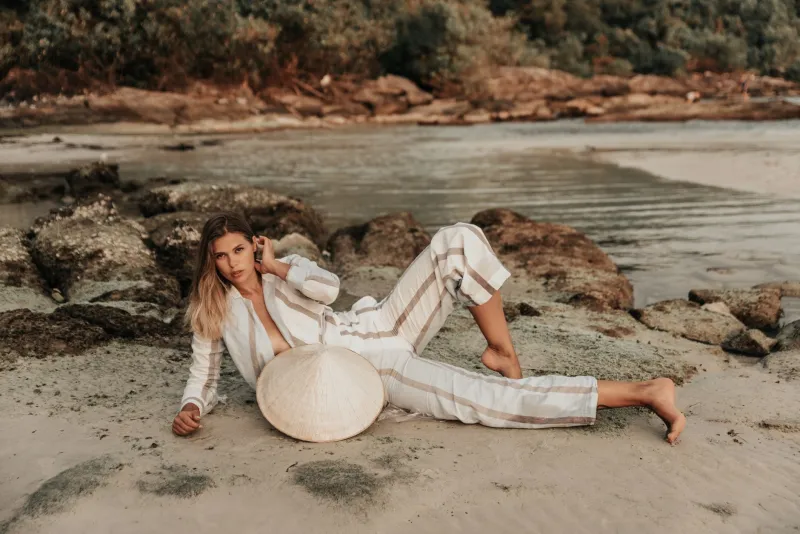
But something's shifted. Scroll through the style corners of TikTok or Pinterest right now and you'll notice a quieter current running underneath all the noise. Linen in warm ivory. Woven bags. Bare skin. Minimal gold. The vibe is sun-warmed and stripped back — like someone packed for a two-week trip to a tiny island and somehow nailed every single outfit. That's tropical minimalism, and it's not a trend. It's a reckoning.
The 'More Is More' Hangover Is Real
Here's the thing about maximalism: it's exhausting. Not just for your wallet or your closet space, but genuinely, cognitively exhausting. When everything is a statement, nothing lands. The psychology behind decision fatigue is well-documented — too many choices actually makes us feel worse, not better. And after a few years of buying more, layering more, and curating feeds that looked like a fashion week front row exploded into a thrift store, a lot of Gen Z is waking up with a style hangover.
The pivot toward simplicity isn't about playing it safe. It's about playing it smart. When you strip your wardrobe down to pieces that genuinely work — that feel good on your skin, that photograph well in natural light, that you'd reach for on a Tuesday morning without even thinking — you're not settling. You're editing. And editing, it turns out, is one of the most powerful things you can do for your personal style.
What Tropical Minimalism Actually Looks Like
Let's be clear: this isn't beige-on-beige quiet luxury for people who summer in the Hamptons. Tropical minimalism has a warmth to it, a softness, a hint of something coastal and carefree that feels distinctly Coco Young at its core.
Think natural fibers — linen, cotton, hemp, bamboo — in a palette that pulls from the actual tropics: warm whites, sandy neutrals, soft terracotta, faded sage, the occasional deep ocean blue. Think silhouettes that breathe. Loose trousers. Slip dresses. Oversized button-downs worn open over a simple tank. The kind of outfit that looks effortless because it actually is effortless.
Accessories are minimal but intentional. One good pair of earrings. A woven or leather bag that's been worn in just enough to have character. Sandals that could take you from a farmers market to a rooftop without missing a beat. Nothing is trying too hard, and that's exactly the point.
The Sustainability Connection Nobody's Talking About Enough
There's a reason this aesthetic leans so hard into natural materials, and it goes deeper than aesthetics. Gen Z has grown up with climate anxiety baked into their daily reality. The relationship between fast fashion and environmental damage isn't abstract — it's personal. It's the reason secondhand shopping went from niche to mainstream, and it's the same reason a lot of young shoppers are choosing fewer, better pieces over haul culture.
Natural fabrics aren't just prettier or more breathable (though they are both of those things). They're also more biodegradable, often produced with a smaller environmental footprint, and they last. A well-made linen shirt doesn't pill after three washes. A quality cotton dress doesn't lose its shape. When you invest in pieces that are built to actually go the distance, you're opting out of the cycle that keeps fast fashion profitable — and that's a genuinely radical act dressed up in the most chill aesthetic imaginable.
The Psychology of 'Enough'
Here's what nobody tells you about owning less: it actually feels more luxurious. Not in a deprivation way, but in the way that a really good meal at a small restaurant with a short menu feels more special than an all-you-can-eat buffet. Scarcity, when it's intentional, creates appreciation.
When your wardrobe is curated down to pieces you genuinely love, every morning gets easier. You're not digging through a pile of impulse buys looking for that one thing that actually makes you feel like yourself. You already know where everything is. You already know it works. There's a kind of confidence that comes from that clarity — a groundedness that shows up in how you carry yourself, not just how you dress.
Psychologists who study material possessions and wellbeing have found this over and over: the emotional payoff of owning things peaks fast and fades fast. But the emotional payoff of owning the right things — pieces tied to identity, values, and genuine pleasure — sticks around. Tropical minimalism, at its core, is just applied version of that research. It's dressing with intention instead of impulse.
How to Start Your Own Edit
If your closet currently looks more maximalist than minimal, don't stress. The shift doesn't have to be dramatic or happen overnight. Start with what you already have.
Pull out everything you own and ask yourself one honest question: does this feel like me, or does this feel like a version of me that was trying to keep up with something? The pieces that feel like you — keep those. The ones that feel like performance, like trend-chasing, like you bought them because they were everywhere for a second — those are the ones to let go.
From there, think about gaps. What natural-fabric staples are you missing? A good linen set? A versatile woven tote? A slip dress in a warm neutral that works for basically everything? Build slowly and deliberately. Prioritize quality over quantity every single time.
And lean into the coconut energy. There's a reason this aesthetic feels so good — it's rooted in ease, warmth, and the kind of natural beauty that doesn't need much help. That's not a style choice. That's a whole philosophy.
The Comeback Is Already Here
Tropical minimalism isn't coming. It's already arrived, quietly and without announcement, the way the best things usually do. It's showing up in the way people are shopping, the way they're editing their closets, and the way they're talking about fashion — less as a competition and more as a form of self-expression that actually feels sustainable, literally and emotionally.
The maximalist era gave us permission to be loud and take up space, and there's real value in that. But the coconut comeback is giving us something different: permission to slow down, to choose less and mean it more, and to dress in a way that feels as good as a warm breeze off the ocean on a day when you have absolutely nowhere to be.
That's not settling. That's arriving.